|
InfraredHeaters.com Questions? 1-800-442-2581 |
Our secure online
ordering website: www.MorElectricHeating.com.
|
| Home | Products | Accessories | Ordering | Contact Us | Search | ||
 |
||
|
InfraredHeaters.com Questions? 1-800-442-2581 |
Our secure online
ordering website: www.MorElectricHeating.com.
|
| Home | Products | Accessories | Ordering | Contact Us | Search | ||
|
||
Cooking and Warming of Food with
Infrared Heaters


Infrared heaters are commonly used for applications in the food industry. Ceramic heaters are ideal because they are impervious to splashes of cold water, will not shatter and are ideal for a clean environment where food is being prepared. Aluminum Face Radiant Panel Heaters are also easy to clean. Metal Sheathed Tubular Radiant Food Warmers are used to maintain serving temperatures.
Ceramic Elements and Food Applications
Fast food to fine dining, commercial food producers, and food equipment manufacturers. They can also be used in a variety of
processes as listed below.
Baking
Ceramic elements have been used for making ovens for many years. Even though the concept is the same, they have not been used for baking
food. Existing oven adaptation might be difficult, but new oven construction is a unique possibility. The oven would function with the same
combination convection and radiant heating pattern as traditional ovens, but with the added energy efficiency ceramic heaters offer. Their
clean and washable ceramic surface are an added benefit for required hygienic conditions. Conveyor oven systems are even more suitable for
ceramic use and more conducive to retrofit.
Warming
Restaurant Use
Food warming is already a popular application from fast food restaurants such as Kentucky Fried Chicken to exclusive fine dining kitchens
as found in the Grand Plaza Hotel in Grand Rapids, MI. They provide a gentle, even heat without fear of corrosion or breakage. The
manufacturers of food equipment also need to be made aware of the ceramic heater option and its benefits.
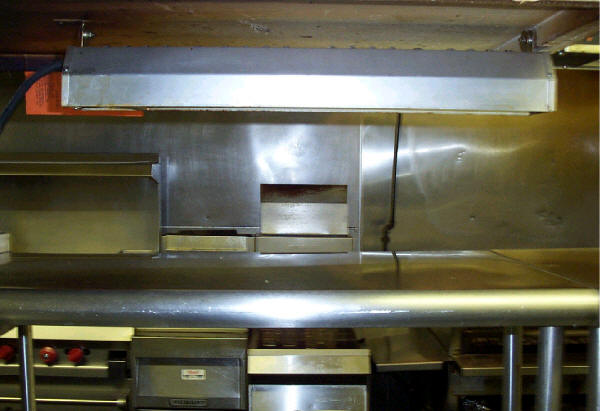
Ceramic Infrared Heaters are becoming more and more popular for use by restaurants for keeping food warm. McDonalds, Wendys, Taco Bell and Kentucky Fried Chicken, to name a few, are already buying them through their purchasing channels, so don’t spend time trying to sell the product to individual restaurants of fast food chains. But what is good for the fast food chains can also be good for privately owned restaurants or smaller networks of locally owned eateries.
The most obvious use is for food warming, using the element(s) above the food in areas where light is not needed to display the food. Light can break down nutrients which can alter taste. Ceramic elements often replace metal-sheathed elements which corrode due to the moisture of the food causing unsanitary rust to develop and even lead to premature burnout. Ceramic elements are moisture resistant with a washable surface much more conducive to cleanliness. Don’t forget the ESE element which can be a perfect warmer for individual dishes or when portable heating is needed.
Another application, recently brought to our attention, is using the emitter under the food to be warmed, creating a warming table or space.
All eating establishments use heat to keep their food warm. The traditional and now outdated methods are to use tubular metal-sheathed heaters, or light bulbs. It shouldn’t take much “selling” to convince of the advantages of using Salamander ceramic heating elements. To help you out, we have designed the back of this month’s newsletter to use as a brochure to either drop off or mail out to your local restaurants. They may be able to retrofit the elements themselves. If not, use the Request for Infrared Application Layout and Design, found in the December 2001 newsletter, to help you get the fastest and most accurate quote for their warming application.
The newest source for:
|
If you are currently using: Metal tubulars You could experience: Corrosion Rust Breakage Glass fragments Uneven heating Heat loss |
When you switch to: Salamander
You will experience: Shatter resistance from water/splashes Rust resistance Wipe clean surface Solidity Gentle even heat & |
Dehydrating
Research and development work done on an apple dehydrating application proved ceramic heaters to be both effective and efficient. Elements
may be used in small single unit machines or large conveyor systems. Along with food dehydration, are agricultural applications such as
grain drying.
Broiling
A ceramic element certainly doesn't look like a traditional broiling element but it can have a high enough watt density to function like one.
Ironically, the shape of a ceramic element provides an advantage in broiling. It can provide much more even heating over a wider area. The
HSE (square element) is a good example of the surface area coverage as opposed to a tubular element. Using one or more HSE elements in a
small table top broiler or larger commercial broiler could provide obvious benefits.
Toasting
Toaster ovens have as much of a potential for ceramic heater use as broiling. The cleanliness of ceramics can be a strong selling point for
both applications since one causes spattering and the other crumbling. The ease of cleaning a ceramic element can prevent grease or food
build up that can interfere with heating effectiveness, smoking or burning, and harbor harmful bacteria.
Melting
Ceramic heaters are ideal for a melting operations such as chocolate or cheese. Their gentle, even heating can be easily controlled for such
heat-sensitive procedures.
|
We are a distributor of infrared heaters. Always consult manufacturers installation instructions for proper installation of the products or systems shown on this website. © Copyright 1999-2019 Mor Electric Heating Assoc., Inc. MOR
ELECTRIC HEATING ASSOC., INC. |
|