|
InfraredHeaters.com Questions? 1-800-442-2581 |
Our secure online
ordering website: www.MorElectricHeating.com.
|
| Home | Products | Accessories | Ordering | Contact Us | Search | ||
 |
||
|
InfraredHeaters.com Questions? 1-800-442-2581 |
Our secure online
ordering website: www.MorElectricHeating.com.
|
| Home | Products | Accessories | Ordering | Contact Us | Search | ||
|
||
Infrared (Radiant) Heating Basic Information
Links to other pages with infrared heat information:
Frequently Asked Questions about
Infrared Heating
Frequently Asked Questions about Ceramic
Infrared Heaters
Heating, Curing, Cooking and Drying with Infrared Heaters
Ohm's Law: Watts, Volts, Amps, Ohms
Links to information in this page:
Heat Transfer
Electromagnetic Energy
What Exactly is Infrared Heat?
Infrared Absorption and
Reflection Rate of Materials
Types and Comparisons of Electric Infrared
Heaters
Properties of Infrared Radiation
Theory of Infrared Heating
Advantages of Infrared Heating
Total Area Heating
Reflectors and Beam Patterns
Amazing Infrared Power
  Fostoria Electric Infrared Heating Manual in .pdf
format (Comfort Heating and Snow/Ice Control) 32
Pages, 6.5 mb)
Fostoria Electric Infrared Heating Manual in .pdf
format (Comfort Heating and Snow/Ice Control) 32
Pages, 6.5 mb) |
You must have the free Adobe Acrobat Reader plug-in. |
 |
| Heat transfer Heat transfer is the process of heat energy flowing from a source at a high temperature to a load at a lower temperature. The three forms of heat transfer are conduction, convection, and radiation (infrared.) Conduction occurs when there is a transfer of heat energy due to a temperature difference within an object or between objects in direct physical contact. Convection is the result of a transfer of heat energy from one object to another via a moving fluid or gas. Radiation heat transfer can occur by infrared, ultraviolet, microwave and radiowaves. Infrared (electromagnetic radiant infrared energy) is the transfer of heat energy via invisible electromagnetic energy waves that can be felt as the warmth from the sun or a downwind fire or other hot object. |
Electromagnetic Energy
Infrared rays are part of the electromagnetic spectrum:
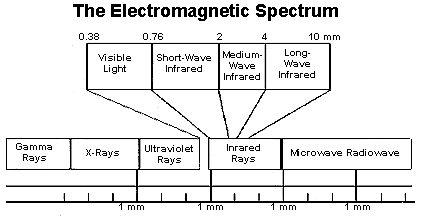
This image displayed with permission of Fostoria
Industries
Infrared energy travels at the speed of light without heating the air it passes through, (the amount of infrared radiation absorbed by carbon dioxide, water vapor and other particles in the air typically is negligible) and gets absorbed or reflected by objects it strikes. Any object with a surface temperature above absolute zero, - 460 ° F ( -273 °C) will emit infrared radiation. The temperature of the object as well as its physical properties will dictate the radiant efficiency and wavelengths emitted. Infrared radiation can be compared to radio waves, visible light, ultraviolet, microwaves, and x-rays. They are all electromagnetic waves that travel through space at the speed of light. The difference between them is the wavelength of the electromagnetic wave. Infrared radiation is measured in microns (mm) and starts at .70 mm and extends to 1000 mm. Although the useful range of wavelengths for infrared heating applications occurs between .70 mm to 10 mm. For more information see our Technical Manual page about the Infrared Part of the Electromagnetic Spectrum.
What Exactly is
Infrared Heat?
Infrared heating is the transfer of thermal energy in the form of electromagnetic
waves. True infrared heat should have one common characteristic: that the transfer of heat
is emitted or radiated from the heated object or substance. The source emits radiation at
a peak wavelength towards an object. The object can absorb the radiation at some
wavelength, reflect radiation at other wavelengths, and re-radiate wavelengths. It is the
absorbed radiation that creates the heat within the object.
Infrared heating varies by efficiency, wavelength and reflectivity. It is these characteristics that set them apart and make some more effective for certain applications than others. Varying levels of efficiency are possible within IR heating and often depend on the material of the heat source. The basic measure of efficiency lays in the ratio between the energy emitted and the energy absorbed, but other considerations may affect this measurement. One is the emissivity value of the heat source as based on the perfect 'black body" emissivity level of 1.0. Ceramic heaters are capable of 90% or better emissions as opposed to the lower values of other heater substances.
The useful range of wavelengths for infrared heating applications fall within the range of 0.7 to 10 microns (mm) on the electromagnetic spectrum and are termed short-wave, medium-wave or long-wave. The medium to long range wavelengths are most advantageous to industrial applications since almost all materials to be heated or dried provide maximum absorption in the 3 to 10 mm region. Energy from an infrared heat source that also emits light (short-wave) will typically emit 80% of its energy around the 1mm wavelength, where as the ceramic infrared heater emits 80% of its energy around the 3 mm wavelength.
The emission efficiency of the infrared heating element itself is not enough since they are used within a fixture. The reflectivity of the fixture greatly contributes to the overall efficiency of the heater. Salamander elements are housed within the effective combination of an stainless steel reflector.
Infrared
Absorption and Reflection Rate of Materials
For absorption and reflection percentage rates for specific materials see our Physical Properties of Materials table. For exact wavelength
absorption and reflection for selected materials see our Spectral
Absorption Curves.
Types of Electric Infrared
Heaters
Some of the types of industrial electric infrared heaters are ceramic elements, quartz tubes and lamps,
quartz emitters, flat faced quartz, glass
and metal panel heaters, metal sheathed tubular (calrods,)
and open coil wire elements.
Comparing Infrared Heaters
Radiant Efficiency of Various Heating Elements
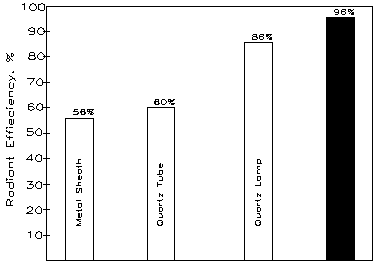
Ceramic Heaters are the highest at 96% efficient in converting electricity into infrared
heat.
When comparing all the different types of heaters on efficiency, life expectancy, zoning ability and other factors, ceramic elements and quartz tubes are the preferred heaters, especially for complex sheet-fed thermoforming applications. Metal sheathed tubulars have a low initial cost but rate low in all areas except durability. For more information see our Technical Manual page about Comparing Infrared Heaters.
In Search of the "Best" Heater
The day has still not arrived when we can manufacture a heater that can do all things. That’s why a knowledge of the strengths and weaknesses of all types of heaters is the only way to successfully make choices for specific applications. The four major heat types to be considered are: metal sheath, quartz tube, quartz lamp, and ceramic.
Similarities in the above types of heaters are less important than the differences. They are all good heaters, depending on what application they are being used in. It is also important to realize that some applications may benefit most from using a combination of heat types. By having a good knowledge of the differences of the various heat types, and using a simple process of elimination, it can be easy to match the best heater for an application. Using a combination of heaters can be a little more difficult and in considering it, each phase of the process should be evaluated by the same criteria.
The following are simple explanations of the most appropriate usage for the four heater types:
Metal-sheath elements- are best used for convection heating needs, such as ovens. They are rugged, cost effective for the application, and efficient. For example, metal-sheath elements can be found in every electric household oven.
Quartz tubes- are best used for radiant applications that need instant on, instant off, such as heat sensitive materials that may have to linger in a heat source.
Quartz lamps- are also instant on and off but made in extremely high watt density. These are effective for high speed production processes.
Ceramic elements- are best used for processes requiring an even, gentle heat and where there is a need for zone control.
Wavelength and emissivity value of the material being heated are also essential for heater selection. Though emissivity charts should be used with specific formulas to calculate the wavelength requirements, a simple generality is "the hotter the heating element, the shorter the wavelength." The absorption rate of the material would then need to be considered as to which wavelength would be appropriate. Another generality is "the higher the absorption, the longer the wavelength requirement." A more detailed explanation of wavelength and emissivity will be covered in a future newsletter.
The following chart is designed to help with the process of heater selection when asking these specific questions:
| Ceramic Emitters | Metal Tubulars | Quartz Tubes | Quartz Lamps | |
| How quickly must the heater reach maximum temperature? Response time: | ||||
| Slow | Slow | Fast | Instantly | |
| How does the lifespan of the heater relate to cost of a replacement, and this cost relate to the cost of the end product? Lifespan: | ||||
| Excellent | Excellent | Good | Good | |
| Does the application require a durable heater? Durability: | ||||
| Good | Excellent | Poor | Poor | |
| How does the efficiency of the heater relate to the cost, and this cost relate to the end product? Infrared efficiency: | ||||
| 96% | 56% | 61% | 85% | |
| Would the application benefit from zone control? Controllability with an integral thermocouple: | ||||
| Yes | No | No | No | |
| What is the maximum temperature required to heat the material? Maximum operating temperature: | ||||
| 1292 °F (700 °C) | 1400 °F (760 °C) | 1600 °F (871 °C) | 2500 °F (1371 °C) | |
| Compare the cost of the heater with the budget of the application. Cost: | ||||
| Medium | Low | Medium | High | |
| Installation and replacement time must be considered as part of the "cost" of operation. Installation: | ||||
| Moderate | Easy | Moderate | Difficult | |
| What wavelength does the material require? Wavelength: | ||||
| Medium | Medium | Short | Short | |
| Which heater will work most effectively with the emissivity level of the material? Emissivity of material: | ||||
| High | High | Low | Low | |
Properties of Infrared Radiation
Reprinted with permission of Fostoria Industries. We are an authorized distributor for Fostoria, a manufacturer of infrared heating elements, reflectors, assemblies and complete infrared heating systems.
There are several physical laws that explain the properties of infrared
radiation. The first and probably most important of these laws states that there is a
positive relationship between radiant efficiency and the temperature of an infrared
source. (Radiant efficiency is the percentage of radiant output from a heat source).
The proportion of energy transmitted from a heat source by each of the three heat source
methods is dependent on the physical and ambient characteristics surrounding the heat
source, and in particular the source's temperature.
The Stefan-Boltzman Law of Radiation states that as the temperature of a heat source is
increased, the radiant output increases to the fourth power of its temperature. The
conduction and convection components increase only in direct proportion with the
temperature changes. In other words, as the temperature of a heat source is increased,
a much greater percentage of the total energy output is converted into radiant energy.
The wavelength of infrared radiation is dependent upon the temperature of the heat source.
A source temperature of 3600 °F will produce a short-wave of approximately 1mm, while a source temperature of 1000 °F will produce a long-wave
of approximately 3.6 mm. The wave-length dramatically impacts
the intensity of radiation at the subject.
A critical function of the wavelength of infrared radiation is its ability to
penetrate an object.
The penetration of infrared energy is a function of its wavelength. The higher the
temperature the shorter the wavelength. The shorter the wavelength, the greater its
penetrating power. For example, a tungsten filament quartz lamp operating at 4000
°F., has a greater ability to penetrate into a product than a nickel chrome filament
quartz tube operating at 1800 °F.
There are certain advantages gained in industrial processing by using the penetrating
capabilities of short-wave infrared. For example, short-wave radiation can be effectively
used for faster baking of certain paints since the infrared radiation penetrates into the
paint surface and flows out solvents from within. Conventional drying methods can form a
paint skin and trap solvents. Some other applications of short-wave infrared include heat
shrinking, water dry-off, and preheating of objects prior to further processes.
Color sensitivity is another characteristic of infrared radiation that is related to
source temperature and wavelength.
The general rule is the higher the temperature of the source, the higher the rate of heat
absorption of darker colors. For example, water and glass (which are colorless) are
virtually transparent to short-wave radiation, but are very strong absorbers of long wave
radiation above 2.
Another characteristic of infrared that is not dependent upon temperature or wavelength is
response time. Sources with heavier mass take longer to heat to the desired
temperature. For example, a tungsten filament has a very low mass, and achieves 80%
radiant efficiency within microseconds. A coiled nickel chrome filament in a quartz tube
acquires 80% of its radiant efficiency in approximately 75 seconds and metal sheathed rods
require approximately 3 minutes.
The rate of response becomes an important consideration especially when applying infrared
to delicate and flammable materials.
Theory of Infrared Heating (Reprinted with permission of Fostoria Industries.)
Infrared radiation is electromagnetic radiation which is generated in a hot source (quartz lamp, quartz tube, or metal rod) by vibration and rotation of molecules. The resulting energy is controlled and directed specifically to and on people or objects. This energy is not absorbed by air, and does not create heat until it is absorbed by an opaque object.
The sun is the basic energy source. Energy is projected 93,000,000 miles through space to heat the earth by the infrared process. This infrared energy travels at the speed of light, and converts to heat upon contact with a person, a building, the floor, the ground or any other opaque object. There is, however, no ultraviolet component (suntanning rays) in Electric infrared.
Electric infrared energy travels in straight lines from the heat source. This energy is directed into specific patterns by optically designed reflectors, Infrared, like light, travels outward from the heat source, and diffuses as a function of the square of the distance. Intensity, therefore, would decrease in a proportional manner. So, at 20’ from the heat source, intensity of the energy concentration is ¼ the intensity developed at 10’ distance.
For comfort heating, there must be reasonably even accumulated values of heat throughout the comfort zone. Proper mounting heights of the individual heaters, fixture spacing, reflector beam patterns, and heat source wattage must be specified to generate the proper heating levels at the task area. The amount of heat delivered is also adjusted by input controllers or by thermostats which respond to surrounding temperature levels and provide ON-OFF or PROPORTIONAL inputs.
Advantages of Infrared Heating (Reprinted with permission of Fostoria Industries.)
1 ) HEATS PEOPLE WITHOUT HEATING AIR Infrared travels through space and is absorbed by people and objects in its path. Infrared is not absorbed by the air. With convection heating the air itself is warmed and circulated ... however, warm air always rises to the highest point of a building. With Infrared heating, the warmth is directed and concentrated at the floor and people level where it is really needed.
2) ZONE CONTROL FLEXIBILITY Infrared heating is not dependent upon air movement like convection heat. Infrared energy is absorbed solely at the area it is directed. Therefore it is possible to divide any area into separate smaller zones and maintain a different comfort level in each zone. For example, Zone A, with a high concentration of people, could be maintained at a 70 degree comfort level while at the same time Zone B. a storage area, could be kept at 55 degrees or even turned off completely.
3) STAGING Another unique control feature of electric infrared that increases comfort conditions and saves energy consumption is staging. Where most systems are either "fully ON" or "fully OFF" the staging feature also allows only a portion of the equipment's total capacity to be used. For example, a two- stage control would work as follows: During the first stage, one heat source in every fixture would be energized. During the second stage, two heat sources in every fixture would be energized. For further control sophistication, a large area can be both zoned and staged. These systems, then, allow a more consistent and uniform means of maintaining a specific comfort level and avoid the "peak & valley" syndrome.
4) REDUCED OPERATING COSTS The previous statements are advantages in themselves; but combined they account for an energy/fuel savings of up to 50 percent. Actual savings will vary from building to building depending on factors such as insulation, ceiling height and type of construction.
5) INSTANT HEAT Electric infrared produces virtually instant heat. There is no need to wait for heat buildup. Turn the heaters on just prior to heating requirements.
6) NEGLIGIBLE MAINTENANCE Electric infrared is strictly a resistance type heat. There are no moving parts or motors to wear out; no air filters or lubrication required. Periodic cleaning of the reflectors and heat source replacement is all that will be required.
7) CLEAN Electric infrared, like other forms of electric heating, is the cleanest method of heating. There are no by-products of combustion as with fossil fuel burning units. Electric infrared adds nothing to the air nor takes anything from it.
8) SAFE
9) EFFICIENT All Electric Heaters convert energy to heat at 100% efficiency.
Total
Area Heating (Reprinted with permission of Fostoria Industries.)
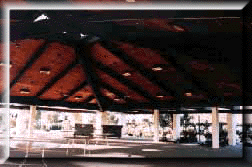
In electric Infrared heating for ‘Total Area’
heat design, the actual fixture layout parallels
closely the approach used in a general lighting system, but without as much permissible
latitude. The allowable range of air temperature people accept as "comfortable"
is very limited. Deviations of a few degrees from the preferred comfort temperature
greatly affect a feeling of being too warm or too cold. For this reason, assumptions or
rough approximations of critical factors in an indoor total heating system design must be
minimized.
In electric infrared heating systems, it is important to know that air temperatures can be lower than temperatures with conventional heating systems, while giving the same degree of comfort to the occupants. The reason is that much of the heating affect on the occupants comes directly from the radiant energy produced by the heating elements. The infrared system also makes the temperature of the floor and surfaces higher than the surrounding air temperature.

The function of an electric infrared ‘Total Area’ heating system is to supply the right amount of heating where needed to maintain a constant desired comfort level. An effective heating system brings the room surfaces and air up to temperature and holds them constant despite changes in outside air temperature or variations in heat losses. If the infrared equipment is carefully selected and properly installed (to project heat downward in a uniform distribution pattern over the floor area), excellent ‘Total Area’ heating efficiency can be expected.
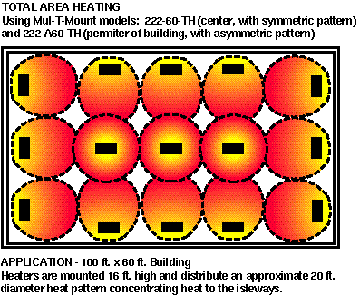
Reflectors
and Beam Patterns (Reprinted with permission of Fostoria Industries.)
The method of transferring and directing the infrared energy to
the work level is an important factor in the heating design and will greatly affect the
efficiency of the heating system.
Reflectors are used to direct the radiant energy from the source to the work area. The higher the efficiency of the reflector, the more radiant energy will be transferred to the work level. The reflector efficiency is influenced by the reflector material, its shape and contour.
One method of measuring the efficiency of the material is by the emissivity factor. Emissivity is defined as the ratio of the amount of energy given off by radiation from a perfect black body; and is equal to the rate that material will absorb energy. The lower the emissivity number the less the material will absorb; hence the better the reflectivity of the material.
Few materials can be considered for use as reflectors in comfort heating equipment. They must have high reflectivity of infrared energy; resist corrosion, heat, moisture; and be easily cleaned.
Aluminum is a common reflector material and must be anodized to provide suitable reflectivity and withstand the heat levels present in an infrared heater. Gold anodized aluminum is best suited as a reflector material when the combined factors of cost, workability and weight are considered. Dirt will accumulate ON the surface and not IN the chemical composition with the gold. Within the infrared energy portion of the spectrum, clear anodized aluminum reflectors achieve approximately 92 percent reflectivity. The most highly efficient reflector readily available is a specular gold plate material, which is rarely used due to the prohibitive cost of gold. Fostoria uses gold anodized aluminum for reflectors and end caps in their electric infrared heating equipment to provide the highest economical reflectivity and durability.
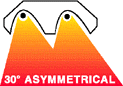
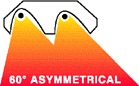
The beam pattern created by the reflector must be emphasized in the heating design. First the reflector must create a straight vertical line from the heat source to the work area. This is the pattern centerline. Secondly, the reflector will converge or concentrate the energy into a choice of wide, medium or narrow patterns. In the electric infrared comfort heat industry, reflectors are also designed for asymmetric, symmetric and offset patterns as show below.
 ---
--- ---
---
 ---
--- ---
---
Amazing Infrared Power
 The power of infrared can be seen as the sun bathes the Earth in infrared energy 24 hours
a day and contributes to the greenhouse effect on Earth. The ocean and continents absorb
most of the energy. The clouds also absorb much of the infrared and that is why you do not
feel as much warmth from the direction of the sun when the sky is cloudy.
The power of infrared can be seen as the sun bathes the Earth in infrared energy 24 hours
a day and contributes to the greenhouse effect on Earth. The ocean and continents absorb
most of the energy. The clouds also absorb much of the infrared and that is why you do not
feel as much warmth from the direction of the sun when the sky is cloudy.
|
We are a distributor of infrared heaters. Always consult manufacturers installation instructions for proper installation of the products or systems shown on this website. © Copyright 1999-2019 Mor Electric Heating Assoc., Inc. MOR
ELECTRIC HEATING ASSOC., INC. |
|